Showing posts with label theory. Show all posts

Thursday, 18 October 2012

Editing

Hollyoaks


 There are approximately 44 shots in the opening sequence, these are all very fast paced, jump shot edits. They all contain a shot of each character and props that relate to the personality of their character. All the transitions are very simple and fast cuts. The duration of these are all very short and this maybe reflects the short stories the characters are all involved in, in the tv drama and how many different relationships there are going on.
All the characters are stood infront of what seems to be a green screen as there are lots of different animated things going on in the background of their shots that relate to their personalities, status and all the current activities they taking part in, in the drama. For example Brendan is playing with cards in the last opening shot because his character is a gambler, very secretive and sly. Whereas, Dodger's character is surrounded by the silhouettes of girls because his charcter is known to be a 'ladies man'.

Wednesday, 17 October 2012

Representation of Tony Stonem

How is Tony Stonem represented in Skins?


Tony Stonem is represented in a very different way in Skins to how normal teenagers his age would act. The stereotypical teenager is seen to be lazy, messy and irresponsible. Whereas Tony is completely different to this stereotype, he is represented  in this clip as very neat, controlled and responsible, he is shown to be a very pedantic character.

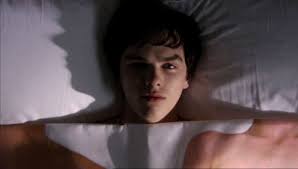
The first initial shot we see of Tony is a close up of his face, from this we can see the smug look of pleasure on his face as he has conveniently woken up before his alarm has gone off. The shot then pans out into a high angle shot where we see Tony lying in his bed under a duvet of a naked man and woman, funnily enough we see Tony in the middle of these two naked figures, this gives us the impression that maybe Tony is undecided of his sexuality being 'stuck in the middle' or maybe that he is bisexual being in the middle of the two genders.

The shot then jump cuts to Tony's alarm going off and him getting out of bed very swiftly. From this shot we can see Tony's room is very neat and tidy, his room is illuminated by the bright sunlight coming through the window, showing his room to be very clinical and bland, this could show a reflection of Tony's personality and proves my previous point of him not being a 'normal' teenager, as we would expect his room to be very messy and dark. We then see that he clearly has a daily routine when he gets up; turning off his alarm, stretching, working out, watching the woman across the street get dressed and then getting dressed himself. Filming all of this includes camera shots as mid shots of Tony's torso, long shot of Tony in the window and over the shoulder shot of the woman in the window across the street. We then move to a high angle shot of Effy walking down the street obviously looking worn out as she is scantily dressed from a night out. This is very ironic as we instantly see the massive contrast between the two siblings. On one hand we have Tony who isnt the 'typical' teenager: he is very organised, neat, well dressed and pedantic and on the other hand we have his younger sister Effy who is very much a stereotypical teenager: rebellious, sneeky and messy. The high angle shot of Effy shows her vunerabilty being the youger sibling and Tony looking down on her as the older, more responsible brother.
Tony then pretends his CD player has broken, and distracts his dad whilst Effy sneaks in.
The sound used throughout the clip so far has been very varied. We move from the diegetic sounds of the church bells ringing and birds singing to the non-diegetic music which is pulsating and slow, building the scene up. We then return back to diegetic music as Tony puts his soundsystem on which is much more fast paced and louder and reflects the chaos he is about to cause by playing it and diegetic sound as his Dad comes in swearing and shouting at the high volume of the music. The dialogue between Tony and his Dad seems very well rehearsed like this isnt the first time Tony has woken his parents up to music blasting, we know this as his Dad says "every fucking morning" and the look on Tony's face shows he takes pleasure in winding up and annoying his Dad so easily.

We are then taken to a shot of Effy's room, which reinforces my point of her being a very stereotypical teenager. Her room is messy, decorated with bright colours and hardly illuminated at this time in the morning, the dark state of her room could represent the dark side to her personality which her parents obviously have no idea about and is masked by the decor  of her room being so childish and girly.

We then move on to the next scene where Tony purposely locks himself inside the bathroom just to annoy his Dad, he then climbs out of the window, down the drainpipe and back into the house to take a seat in the kitchen. he does all of this whilst his Dad still thinks he is in the toilet, until his Dad comes downstairs and to his dismay sees Tony sat at the table eating his breakfast quite arrogantly and looking very smug at how easily he can annoy his Dad, we see Tony taking great pleasure in doing this which returns us back to the actions of a stereotypical teenager; going out of his way to annoy and wind up his parents. Tony is represented to have a very mistured and varied personality, some sides of him being very different to your average teenager and other sides being quite a normal annoying teenager. Tony however, over all doesnt seem to conform to the normal expectations of a teenager, whereas Effy does and having the contrast between the two siblings highlights the differences in how they act in everyday life, which isnt seem to be the norm for most teenagers in the UK.

Thursday, 4 October 2012

Kick-ass Filmmaking

kick-ass-2010-01


The idea:

The idea behind the film Kick-ass was taken from the comic book Kick-Ass which is a creator-owned comic book series written by Mark Millar. The film was produced by Matthew Vaughn and co-produced by Brad Pitt, Vaughn also directed Kick-ass. The comic book was orginally written by Mark Millar, but the film was co-wrote with Jane Goldman and Vaughn himself. At first Millar had the idea to bring comic book to the big screen and thats where he met jane Goldman who then introduced him to Matthew Vaughn (with whom she co-wrote the film Stardust with beforehand). Millar then pitched the idea to Vaughn who loved it and they plotted the whole film together in one afternoon.

Development Finance:

At first Kick-ass struggled to get a production company that would accept the script for what it was without any tweaks (such as decreasing levels in violence and swearing) in total seven production companys turned down the script before Vaughn released it through his own production company.  The big studios also doubted the success of the adaptation as a violent superhero, which forced the film to be independently financed by Vaughn however this gave him the freedom to make the film the way he imagined, without having to worry about any sensoring. However, Vaughn also had the help of Brad Pitt, which then meant because Pitt owns a film production company (Plan B Entertainment) that holds a release deal with Paramount Pictures, Warner Bros. and 20th Century Fox, Kick-ass now had a studio to film in.The film's budget was $30 million and its total income was approximately $96,188,903.

Script Development:

After meeting Vaughn, Millar then wrote a synopsis and then in parallel Millar wrote the comic and Vaughn wrote the script. This meant from the start Kick-ass was different from most other comic book movies, this was due to the fact the movie was in development at the same time as the comic book. Then, Vaughn wrote a first draft focusing on structure and story before Goldman added the dialogue and characterization, Goldman described her work with Vaughn as her job being the "construction work" and the "interior designing" while Vaughn acts as the "architect."

Packaging:

With the film deep in pre-production, Vaughn faced the scenario where he struggled to find an actor to fit the bill of 'Kickass' himself. In the struggle to find an actor to fit the character of Dave (Kickass) Vaughn almost had to pull the movie back six months, even though he had cast all the other roles. Then, Sarah Finn and Lucinda Syson (Vaughn's casting directors), encouraged him to take a look at a tape from a young actor called Aaron Johnson, which Vaughn had already previously turned down without viewing. Then after hearing Johnson read for the first time, Vaughn knew immediately Aaron would fit the role of Dave perfectly.

Production:

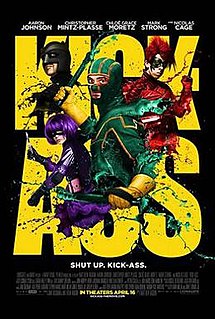
Kick Ass Movie PosterAs pointed out before Kickass was an independantly financed film due to the big studios doubt in the film's success. Christopher Mintz-Plasse, (Red Mist), said that the creators of the film were wondering whether a distributor would pick up the movie. On the set Vaughn jokingly referred to Kick-Ass as something that was going to be "the most expensive home movie I ever made."
The filming locations for Kickass include Hamilton, Ontario, Canada; Dip 'N' Sip Donuts on Kingston Road in Toronto, Sir Winston Churchill Secondary School, and "many Toronto landmarks that play cameos"; and various locations in the UK: Elstree Studios,
Whiteleys Shopping Centre in Bayswater London and Pinewood Studios, Iver Heath, Buckinghamshire. The opening sequence with Nicolas Cage was filmed in a sewage plant in East London.
On the other hand, the 2D/3D animated comic book sequence in the film took almost two years to finish. Romita created the pencils, Tom Palmer did the inks, and Dean White did the colours.
Kick-ass recieved a 15 rating from the BBFC and received an R rating by the MPAA (Motion Picture Association of America) for "strong brutal violence throughout, pervasive language, sexual content, nudity and drug use (some involving children). In an interview with Total Film, Aaron Johnson confirmed that the film stays true to the adult nature of the comic series by featuring a large amount of profanity and graphic violence.
The production companies involved in the making of Kickass were Marv Films and Plan B Entertainment (owned by Brad Pitt) and the  main distributors were Universal Pictures (UK) and Lionsgate Films (US) a full list of distributors and companies involved in the production of Kick-ass can be found on IMDb:
http://www.imdb.com/title/tt1250777/companycredits 


Sales:

Four different trailers altogether were released before Kick-ass premiered. They include the teaser trailer, the extended trailer and the international trailer. At first the teaser trailer caused some controversy due to the explicit language used by Chloe Moretz (Hit-Girl) but they still went on to released a red band trailer which displayed violence and use of the line "Okay you cunts, let's see what you can do now," delivered by ChloĆ« Grace Moretz, who was only eleven years old at the time of filming, this caused and upheaval by family advocacy groups for the use of violence and swearing. Along with this four TV spots were also released prior to the film being released,some fans said that too much footage was being seen too close to the release, however it still went on to be a huge hit in the box office and an even bigger hit in DVD and Blu-ray sales.

Teaser Trailer:


Extended Trailer:


International Trailer:


Red-Band Trailer:


Kick-Ass TV Spot - Story:


Kick-Ass TV Spot - Ordinary Heroes:


Kick-Ass TV Spot - Corridor:


Kick-Ass TV Spot: Big Four:


Marketing:

Kick-AssKick-ass was initially marketed through it original comic-books (published by Marvel Comics under the company's Icon imprint), which a few issues were already in shops to buy and read before the film was released. It also had the usual marketing techniques of posters on buses, in magazines on billboards etc, TV, cinema and DVD trailers. But Kickass was marketed really heavily in its poster and trailer campaigns because it was expected to be a huge success even though it was being surrounded by huge controversy in the early stages of production and development. Kick-ass released four trailers altogether and four TV spots, which some would say is too much coverage and gave too much of the film away. Nevertheless, it still went on to be a huge hit. Some of the main actors also did promotional tours which is where film actors, directors, and producers appear for television, radio, and print media interviews, sometimes showing a clip from the film or an outtake and talking about the film and their role in it. Empire and Total Film magazine covered the film and it's journey from page to screen and film reviews are available on their websites too.The film was also pitched at San Diego Comic-con and the Empire magazine Movie-Con. Kick-ass also took to viral marketing on fan's blogs and websites which showed free distribution of trailers and also gave reviews. Kick-ass also had a test screening in London at the BAFTA which was hosted by the UK distributor Universal, the people that attended this were Universal staff and other European distributors and then a smaller minority being the general public.


Exhibition:

A premier for Kick-ass was held in Leicester Square, London for the film, cast, directors, producers and screenwriters plus other special guests (including Brad Pitt). Kick-Ass made £3,881,704 (UK) on the opening weekend (4th April 2010)  and it was shown on 402 cinema screens across the country and on 5778 screens across the world on the opening weekend alone.
The film was released on DVD and Blu-ray on 3 August 2010 in North America, selling 1.4 million copies within its first week, one-third of these in Blu-ray format. Kick-Ass debuted at number one on the DVD sales chart and the discs were released in the United Kingdom on 6 September 2010.

Other Windows:

The foreground features the superhero Kick-Ass in his green and yellow costume. Against a black background the words KICK-ASS are written in yellow block capitals.A video game produced by WHA Entertainment and Frozen Codebase was released through the App Store on 15 April 2010, then another game was released on PlayStation Network on 29 April 2010. Kickass was nominated for twenty-five awards altogether, eventually going on to win seven of them. It won Best British Film at the Empire Awards and Best Comic-Book Adaptation and Best Blu-ray at the IGN Awards. Young actress Chloe Moretz scooped the other four awards for her perfomance: one as Best Newcomer at the Empire Awards, one at the IGN awards for Best Actress and two at the MTV Movie awards for Best Breakout Star and Biggest Badass Star.


Kick-ass has been reported by Universal (the distributors) for a sequeal Kickass 2
"The costumed high-school hero Kick-Ass joins with a group of normal citizens who have been inspired to fight crime in costume. Meanwhile, the Red Mist plots an act of revenge that will affect everyone Kick-Ass knows." -Synopsis. The same cast are due to return, plus a few new faces. Matthew Vaughn has chosen Jeff Wadlow, who also co-wrote the script along with Vaughn, to direct the sequel with filming planned to begin in September 2012.


Sources:

Wikipedia
IMDb


Binary Opposites (Claude Levi-Strauss)


I have studied the channel 4 soap drama Hollyoaks. Claude Levi-Strauss suggested that narratives are provided with motivation to move from one point to another by the repeated establishing of actual or potential conflict. He saw narratives as having binary opposites. These opposites act upon each other and characters try to control them, causing conflict and resolution.
Here is a table of opposite characters and scenes:

Characters:

Brendan Brady                                                  Jono
(Uptight, Very serious, stressful adult)            (Chilled out, relaxed teenager, stoner)


Cindy Cunningham                                           Phoebe Jackson
(Highly-strung, high-maintenance,girly)          (Relaxed, lazy, laidback appearance, boyish)


Maddie Morrison                                             Carmel McQueen
(Bitchy, judgemental, spiteful)                        (Kind-hearted, sweet, caring)


Mitzeee                                                             Myra McQueen
(Glamour model, sex appeal, pretty,             (Unemployed, curvy/larger build, 'chavvy', single mother of six)
takes interest in appearance, young)


Riley Costello                                                  Jacqui Mcqueen
(Professional footballer, weathly, famous,   (Barmaid, little disposable income if any, 'chavvy')
comfortable/flash lifestyle)


Scenes:

Hollyoaks College                                      The Dog In The Pond pub
(Full of adolescents, learning environment)  (Full of adults, laid back environment)


Student University Halls                              Tony Hutchinson and Cindy Cunningham's flat
(Very basic layout, messy, smelly, plain,     (Modern, clean, expensive)
small)


Levi-Strauss thought of and created this theory with the thought in mind that having binary opposites within narratives creates more interesting potential story lines and a more life-like feel, because in reality everyone is different in many different ways.

Monday, 1 October 2012


Direct Address (Breaking the 4th wall):

Direct address also commonly known as 'breaking the 4th wall' is where a character in a TV drama directly addresses the audience. I found a clip from the BBC Two comedy Miranda in which Miranda Hart's character Miranda commonly breaks the 4th wall with the audience. This is shown at approximately 1.04 minutes in where Miranda says "I literally can't make it any clearer" directly to the camera/audience.

Sound Motif:

A sound motif is a sound or tune associated with an individual character or situation. Viewers can tell from this specific sound  and relate it to a certain character or situation as it is constantly repeated throughout the series and episodes. The example i found was a sound clip from Doctor Who of the Tardis. Every time you hear this sound you know that the doctor has arrived in his Tardis. http://downloads.bbc.co.uk/doctorwho/sounds/tardis.mp3


Parallel Sound:

Parallel sound is when we watch a TV drama and the sound/muisc we hear usually compliments and follows what we see on screen. I got a good example from a Fast and Furious car chase, the background music you hear isnt overpowing or extremely loud but it does add an effect to the chase scene as it builds up a crescendo which creates an intense, exhilerating atmosphere which really suits the face pace and building pressure of the car chase. 

Contrapuntal Sound:

On the other hand we have contrapuntal sound, which is the opposite to parallel sound. Contrapuntal sound does not fit to the images we see on screen, which can add even more of a intense/dramatic effect. The clip i found of this is from the film Insidious one of the scarier scenes where the song 'Tip Toe Through The Tulips' by Tiny Tim is being played on a crackling old-fashioned grammophone with a supernatural ghost dancing along to the dismay of the woman who lives there. This upbeat song being put with a scary scene create a very eery and uneasy atmosphere.

Sunday, 16 September 2012

Attack the Block Research

How It Was Produced:

Big Talk Productions who are famous for Shaun Of The Dead, produced this film with Film4, The UK Film Council and StudioCanal. The block of flats it was filmed in was a composite of different council estates across London. The film itself was shot across London from March to May 2010, with 6 weeks of purely late night shoots. It was filmed on the Heygate Estate in Elephant and Castle, Myatts Field Brixton Oval tube station in Kennington and the Bemerton Estate in Islington. The interior scenes of the flats were filmed at Three Mills Studios in east London. The film's production budget was approximately £8 million.

What It Was Based On:

Attack The Block is a Sci-Fi action/comedy about a group of South London teenagers that find themselves in the middle of an alien invasion where they must fight and defend their home (block of flats) from evil extraterrestrials. The film starts off where a nurse 'Sam' is being mugged by a gang of Black British teenagers, however something crashes from the sky into a nearby car, the nurse uses this confusion to run whereas the gang decide to investigate the car for any valuable assets to steal, whilst doing this one of the gang members is attacked by an unknown creature, which they all eventually kill. This was influenced by something Joe Cornish himself experienced, this inspired him to create the first scene in the film and inject a sci-fi edge to it. It was also inspired by Cornish's great love for sci-fi films he watched as he grew up such as E.T, Critters, Predator and also the gang movies he loved such as The Warriors, Streets of fire and The Outsiders. But more than anything Cornish wanted to create a new genre of film which mixed Fantasy and South London suburban reality.  The film went on to box office £3,615,712, which indicates a huge loss from the millions it cost to make.

Problems That Arose In Making the Film:

A main problem that arose whilst filmmaking, was due to the low budget  3D CGI features were not available for use for special effects, so instead Cornish had to tackle the problem by instead of fully showing the aliens themselves to just suggest they were there by using practical and 'old school' effects. Another problem was due to the film being based on an alien invasion at night in the dark all of the filming had to be done throughout the night, which ended up in 6 weeks of continuous late night filming. Also another problem that was outlined mostly in the US was the use of British slang in the film that could be hard for people abroad to understand and connect with, therefore an idea of having to use subtitles was prompted.

The Directors Views On the British Film Industry:

Cornish describes himself to have been 'lucky' to have made the film with Big Talk Productions who are renowned for making the hit film Shaun Of The Dead. He gives them great credit for 'protecting him' and making it easy for him as the director to focus on making the film.

How They Saved Money, the Technology Used:

Cornish helped to save money mostly on the type of effects they used to produce the film. For example 3D CGI wasnt used to create special effects for the alien but instead they used practical and 'old school' effects such as puppeting and giving the aliens glow-in-the-dark teeth. They also only used CG to remove any unwanted details of the puppets rather than the usual of editing in effects. Although the film wasnt produced using top, highly priced technology like Hollywood films, it still contains the usual action film's explosions, chases, stunts etc. Another huge saving Attack The Block made was the actors/actresses used, all apart from Nick Frost were unknown/new actors some without any experience at all, this made a massive saving but could also have made them lose money because having leading, well known actors/actresses helps to sell a film because of their loyal fan bases, whereas Attack The Block probably didnt get this sort of promotion to help.

Issues With Film Rating & Controversy Surrounding the Film:

Attack The Block had no issues whatsoever about the film rating which was a 15. Or in fact any controversy surrounding the film. It was a highly anticipated film from the British public and was recieved pretty well in Britain for its South London suburban reality and humour.

The Film's Promotion:

Attack The Block was promoted in a number of ways; tv adverts, cinema trailers, teaser trailers, UK & US official trailers, posters, magazine adverts, soundtrack available for purchase on Itunes etc, interviews with tv programmes and journalists in the UK and US, interviews with the director Joe Cornish talking about the upcoming film with journalists in the UK and abroad. The film/media magazine Little White Lies dedicated a whole issue to Attack The Block. Attack The Block got its own special trailer for the US which was specially suited for North American audiences, they also released a new clip of one of the movie’s many tension-building sequences. And most importantly Attack The Block had its own premiere in Leicester Square, London.

The Soundtrack:

The soundtrack for Attack The Block was collectively composed by Simon Ratcliffe, Felix Buxton and Steven Price. Both Simon Ratcliffe and Felix Buxton who are both part of the electronic dance music group Basement Jaxx and then Steven Price who is a British composer. This soundtrack was released on 16th May 2011 it is available to buy on Itunes, Amazon, HMV and more. The soundtrack includes 20 tracks.

5X5


Five television programmes:
Styled To Rock- British reality series on Sky Living, new this year is producer by singer Rihanna to find a fresh new fashion talent with the help of designer Henry Holland, singer Nicola Roberts and Rihanna's personal stylist Lysa Cooper.
Revenge- American television drama about a young woman set to take revenge on those who destroyed her family. Shown in the UK on E4.
New Girl- American television sitcom about an off-beat young woman called Jess who moves into an apartment with 3 single men.Shown in the UK on E4.
Celebrity Juice- British television comedy panel game shown on ITV1 and hosted by notoriously vulgar comedian Keith Lemon (Leigh Francis).
Two Broke Girls-American television sitcom, about two women who work and live together in Brooklyn, New York with the hopes of launching a successful business but first they have to raise the cash. Shown in the UK on E4.

Five Films:
500 Days of Summer- 2009 american romantic comedy starring Zooey Deschanel and Joseph Gordon-Levitt about a young woman who doesnt believe in true love and the young man that falls for her.
The Notebook- 2004 romantic drama based on the novel of the same name, starring Ryan Gosling and Rachael McAdams as a young couple who fall in love in the early 1940s.
P.S I Love You- 2007 American romance/drama about a young widow who goes on a life journey following 10 letters intended to help ease her pain and start a new life which were left by her late husband.
Cool Runnings- 1993 American adventure comedy about the unlikely debut of a Jamaican boblsleigh team. Starring Leon Robinson, Doug E. Doug, Malik Yoba, Rawle D. Lewis and John Candy. 
Step Brothers- 2008 American slapstick comedy about two middle-aged men still living at home who are forced to become roommates when their parents get married. Starring Will Ferrell and John C. Reilly.

Five Bands/Musicians:
Arctic Monkeys- English indie rock band who formed in 2002 in High Green, Sheffield. the band consists of frontman Alex Turner, Matt Helders, Jamie Cook, Nick O'Malley and former member Andy Nicholson.
Azealia Banks- An American rapper, singer and lyricist from Harlem, New York.
Crystal Castles- An electronic/experimental band formed in 2004 in Toronto, Ontario. Band consists of producer Ethan Kath and lyricist and singer Alice Glass.
The XX- English indie band formed in London 2008, band consists of Jamie xx, Baria Qureshi, Romy Madley Croft and Oliver Sim.
Passion Pit- American electropop band from Cambridge, Massachusetts. Formed in 2007, band consists of lead vocals Michael Angelakos, Ian Hultquist, Xander Singh, Jeff Apruzzese and Nate Donmoyer.

Five Magazines:
ELLE Magazine- Worldwide magazine of French origin that focuses on Women's fashion, beauty, health and entertainment. Founded in 1945.
Vogue- American fashion and lifestyle magazine, published monthly in 19 national and one regional edition by Conde Nast, first issue released in 1892.
i-D- British magazine dedicated to fashion, music, art and youth culture. Founded in 1980.
Nylon- American magazine that focuses on pop culture and fashion. Founded in 1999.
Harper's Bazaar- American women's magazine first published in 1867.
Five Female Models:
Kate Moss- Born on 16th January 1974 is an English model managed by Storm Model Management.
Rosie Huntington-Whiteley- Born on 18th April  1987 is an English model/actress.
Cara Delevingne-Born 12th August 1992, is an English model/socialite managed by Storm Model Management.
Poppy Delevingne- Born 15th September 1986 is an english model managed by Storm Model Management.
Alexa Chung- Born 5th November 1983 is an English model/tv presenter/contributing editor at British Vogue.

Tuesday, 11 September 2012

Understanding Filmmaking

Scene One- The Idea

Source one: Sources Of Inspiration

  • Remakes:Charlie and the Chocolate factory was remade in 2005 from the original version produced in 1971 different characters and development in technology all contribute to the success of the new version.
  • Real Life Events:Calender Girls was made from a real life story in 2003.
  • Original Ideas:The film Ted was made in 2012 from an original idea, these are the most valuable commodity in the film industry.
  • Adaptations: The Twilight Saga was adapted first from the author Stephenie Meyer's series of books. The first one being 'Twilight' these books inspired major success and can generate publicity.
  • The Producer:Producers are akways looking for great ideas for new films and its them that decides to make this 'great idea' into a reality. E.g Wlt Disney
  • The Director:A director can visualise a script and make it into a reality, they know how to take a story and put it onto the screen. E.g Steven Spielberg.
  • The Writer:the writer defines and clarifies the whole idea, the plot and the main characters and turns it into something tangible. E.g J K Rowling
  • Treatment:The writer will then write a treatment, a one page description of the plot and the main characters. E.g J K Rowling writes a treatment for The Philosophers Stone.
  • Pitch:A pitch contains all the information the producer needs in order to sell the idea to financiers to commission a script.


Scene Two- Development Finance

Pitching the Project:

  • The producer uses the treatment and pitch, plus their powers of persuasion, to get money to develop a script. 

Production Companies:

  • The produces approaches the film production companies and persuades them that the film is going to make profits, they may offer development money, to develop a script

Sales, Distribution and Broadcast:

  • The producer can offer the future sales and broadcast rights for the film in return for money to develop the script.

Public Investment:

  • The producer can alse apply to a public funding body such as the UK film council for a development grant.

Private Finance:

  • The producer can even pitch the film to private investors, in the hope they will support the project.

Tying down the Writer:

  • The producer can now use the development money to tie the writer down to develop the project.

Scene Three- Script Development

  • Synopsis- The producer and the writer agree/disagree on the key scenes/events in the film
  • Step outline-The step outl;ine contains short written descriptions of all the scenes that will eventually make up the script (detailing action and scene breaks).
  • Drafts- Film script drafts whether first or final drafts dont contain just diaglogue, but also the action and events on screen and even transitions between scenes.
  • Revisions-Once the writer and producer are happy with the draft, it is sent to the financiers who will all have their own ideas
  • Final draft-Once everyone is happy with the script (the director, producer and the writer), it is locked off and becomes a final draft. Now the writer gets paid
  • Sales treatment- The finak stage is the creation of a sales treatment (a synopsis designed to sell the film to potential financiers, in other words an advert for the script).

Scene Four- Packaging

  • What is packaging?- This is where the producer and director must now 'package' the script into a full commerical proposition, which is then ready for financing.
  • The cast- Well known stars are commercial assets and are crucial in attracting funding to a film, some stars are known as Green Light Names (people which are well known in the industry or at the box office to secure financing for a film e.g Tom cruise)
  • The heads of department- Commerciallu successful heads of department carry considerable power in the industry with knowledgeable financiers. These include: The production designer, the editor, the director of photography and 'the package' (the producer's assistant).
  • Detailed budget and production schedule- To turn the film into a proper business propostion, the producer must know how much it will actually cost to make. The producer gets help from a line producer to supervise the budget, hire the crew, approve purchase orders and make sure all departments are doing their jobs properly and within the budget. E.g jane Frazer, Line Producer for Pride and Prejudice.
  • Finance plan and recoupment schedule- Potential investors want to know how the producer plans to raise the money, and how she plans to pay them back. this includes The Recoupment Schedule & The Finance Plan.
  • The 'complete' package- Now the producer has 'packaged' the film into a viable commercial proposition. Now the producer must present this package to a number of potential funders to get money to go on and make the film.

Scene Five- Financing

  • The Market- The producer now has to complete the hardest part of filmmaking, attracting the investment to make the film. The director may also be able to help out at this stage, especially is he is well known in the industry
  • Investment- The main potential sources of invesment are: Private Finance (private individuals willing to invest in film projects), Co-productions (production companies across the globe are reluctant to act as sole investors many are too small or dont want the risk. So they will enter into a partnership with the other production company sharing the costs, the risks and the profits).
  • Pre-sales-The producer can also raise the money from 'Pre-sales' which is selling the rights to the film before it has even been made.
  • Banks and Cap Funding- Some departments of banks specialise in film finance. They invest in commercial projects and also offer loans. E.g HSBC film services.
  • Completion Bonds- Most financiers insist that a completion bond is in place before they agree to invest. This is insurance for the production.
  • 'Green Light'- Once all the essential finding and insurance is secured, the film gets the 'Green Light' i.e. the go ahead.

Scene Six- Pre-production

  • The kick-off meeting-  Once all the heads of department are hired (The casting director, the editor, the head of sound, the director of photography, the production designer, the 1st assisant director and the line producer). The shooting script can then be circulated and pre-production begins in earnest.
  • Casting- The casting director, with the director and producer, begins the long process of identifying and casting the actors. An average film will have over 30 cast members.
  • Storyboard- Storyboards are like blueprints for a film. where every shot is planned in advance by the director and the director of photography with the help of a storyboard artist.
  • Production Design- The production designer plans every aspect of how the film will look, and hires people to design and build each part. this is done with the help of an art director, location manager, construction manager and costume designer. A set model is then made.
  • Special effects planning- Effects shots are planned in much more detail than normal shots and can take months to design and build. The person responsible for all of this is the visual effects supervisor who uses computer technology (CGI) and special physical effects.
  • The production Unit- The 1st assistant director, the line producer and the production manager make up the key logistic triangle  of the production, all having individuals roles to help make the production happen.

Scene Seven-The shoot

  • First day of the principal photography: This is the key moment in the film production, shooting begins, and funding is released.
  • Camera: The camera department is responsible for getting all the footage that the director and editor need in order to tell the story.
  • Lighting and sound: Once the lighting and sound have set up and hair and makeup have been checked the shot can now begin.
  • Acting: The actors as the only members of the film personnel that will be seen by the public, have a lot of responsibility, to make the film a huge success. Actors need to create a plausiable world and pretend that they are not surrounded by the crew of camera men and producers.
  • Special physical effect: Every special effect is carefully constructed and must be filmed with a minimum risk of injury to cast and crew.
  • Chain of command: Film productions are run with milatary precision.If they fall behind schedule, the financiers and insurers may step in.

Scene Eight-Post production
  • Rough Cut: As the processed footage comes in, the editor assembles it into scenes and creates a narrative sequence for the film.
  • Post production sound: Once the picture is locked, the sound department works on the audio track laying, creating and editing every sound.
  • Digital effects and titles: Digital effects are added by specialist effects compositors and titles and credits are added in a compositing suite.  
  • Grade and colour: The final stage of the picture edit is to adjust the colour and establish the fine aesthetic of the film.
  • Final mix: After picture lock, the rough sound mix goes to a dubbing theatre where the sound mixer sets the final levels.
  • Final cut: After the final cut the film reaches full lock, it is now finished and ready for duplication. 

Scene Nine- Sales

  • Selling the product: To help sell the film to distributors the producer secures the services of a sales agent. A specialist in film sales. 
  • The trailer: To help sell the film a trailer is made in order to show busy film buyers the most marketable aspects of the film.
  • Sales Toolkit: The producer and the sales agent collect everything they will need to sell the film to distributors.
  • Taking the film to the market: The market is saturated with films so the producer must go to great lengths to attract attention to the film.
  • Screenings: A high profile screening at one of the top film festivals can be great for generating heat around a film. 
  • Deals: The producer now has a hot product and can negotiate good deals with the distributors around the world. 

 Scene 10- Marketing

  • The marketing team- To help sell the film to distibutors, the producer secures the services of a sales agent, a specialist in film sales. They then process through different marketing methods which is divided into two types ('above-the-line' and 'below-the-line'). 'Above-the-line' includes trailers, TV spots and poster campaigns and 'Below-the-line' marketing is more subtle, involving indirect forms of publicity such as press coverage, product tie-ins and merchandising.
  • The audience- Knowing your audience is essential, and the marketing team runs test screenings to see how the film is recieved.
  • Advertising- The potential audience for the film is targeted with posters, cinema trailers, TV spots and other marketing materials. E.g. The Batman Returns poster campaign on the side of a public bus.
  • Press and media coverage- Television, radio, newspapers and magazines can all help create positive word-of-mouth about a film. Film journalists can help sell a film with good criticism and reviews.
  • The intranet and new marketing models- The birth of digital media and the internet has flooded the world with information, but also made niche marketing possible by being able to aim their project at relevant audiences who are most likely to be interesting in what they are trying to sell rather than wasting money on nationwide advertising for people to just ignore it. E.g. Sci-fi fantasy films being advertised on gaming websites aimed at people who are interested in that genre.
  • Selling the film to exhibitors-  In order to get the film to audiences, the distributors must negotiate a deal with the cinemas to screen it, a cinema programmer will watch all the films available and plan their exhibition schedule, they are the key decision makers in the exhibition world.

Scene 11- Marketing

  • The premier- A high-profile, star-studded premiere is used to launch the film to the public with an explosion of media coverage. This is how fame really helps to sell films, stars have loyal fan bases following their careers already, this is why casting the right actors/actresses is so important. An example of a recent high-profile premiere is 'The Perks Of Being A Wallflower' starring Emma Watson.
  • UK cinemas- The UK has over 3,500 cinema screens, although not all are British-owned, or show British films. Cinemas are the most important market for any film, as success at the box office can guarantee increased revenues in subsequent 'windows' (DVD sales and rentals, hospitality, broadcast, product licensing).
  • Prints and logistics- Distributors supply the exhibitors with prints of the film, the more screens the film is shown on, the more prints are needed.
  • Box office performance- Data about film attendance is collected continuously, and used by the cinemas to decide which films to cancel and which to prolong. if a film is underperformin, cinemas simply cannot afford to risk losing valuable income waiting for a film to become more popular.
  • Revenues- The exhibitors take their share of the box office receipts, after which the distributors recoup their marketing costs. The box office gross is just the starting measure for what everyone involved will make from the film.
  • Recoupment- Once the distributors have been paid, the financiers can recover their investments, as laid out in the recoupment schedule. Even if the film is a hit in the box office , the costs of marketing and exhibiting means that the producer is unlikely to see large profits once the exhibitor and distributor have been paid. So, the profits are most likely to come from DVD sales and broadcast.

Scene 12- Other windows

  • Hospitality- Hospitality sales for hotel channels and in-flight entertainment can bring in millions in additional revenue.
  • DVD and video- UK audiences spend more on DVDs than on cinema tickets, so success on DVD can compensate for box office failure.
  • Broadcast- Television is the final source of revenue. Rights are sold separately for pay-tv showings and terrestrial broadcast.
  • The game of the film- Rights for computer games and other product licenses can be extremely lucrative sources of additional revenue. The is a huge growing popularity in video games and is even seen as a threat to the future of film industry.
  • Profit?- Once the film has made a profit, the producer and key creative people can reap their rewards. But sometimes even if the film has been a big hit, if the deals at the financing stage were not favourable they might not get much back at all.
  • The end?- The final income from a film is never know, distribution continues for years and years and it may even be re-released in the future as an anniversary special  for example.