Showing posts with label Representation. Show all posts
Showing posts with label Representation. Show all posts
Tuesday, 27 November 2012
Sexuality- 90210
Before Teddy has 'come out' to society with his sexuality. Clip shows how society has put him under pressure to 'conform' to the stereotype of an alpha male. Also shows the reaction of one of his friends to this revelation.
After Teddy has 'come out' and confronted society with his sexuality. This clip shows the reaction of his group of friends, who take a positive approach to his homosexuality- shows how society has changed and the acceptance of being gay.

Sexuality-TV Drama
Sexuality definition:
| Noun: |
|
Thursday, 15 November 2012
Disability- A Touch of Frost
How overall we feel the character is portrayed...
The dictionary definition of disability is 'a physical or mental condition that limits a person’s movements, senses, or activities'.
In society today, we tend to sympathise with the disabled, it’s a highly credited subject with an accumulation of charities across the world trying to raise money to care for and give the disabled a 'better life'. This always gives us the impression that the disabled constantly need tending to and looking after as they are handicapped and therefore unable to do anything for themselves.
 In the TV drama A Touch of Frost, we are introduced to a disabled character called Billy who has Down's syndrome. In the clip, the first scene we are introduced to is him walking and even staggering through a woods covered in mud and blood with cuts and grazes on his face and body. As he is walking through the dark mysterious looking woods he is slightly lit up which makes you think that he is guilty of something as he is the only character in the woods looking very uneasy and scared, the fact that he is lit up also highlights this point. The non-diegetic music also adds to the mysterious atmosphere in this scene along with Billy’s dirty and grazed appearance at this time. Billy is then alerted by the diegetic sound of the police searching through the woods with dogs and torches and starts to run away, this again makes the audience think that Billy is guilty, because if otherwise he would have no reason to run apart from if he is scared in the dark (this would also make sense because of his childish nature relating to his disability). But after watching the whole clip you are faced with the storyline that Billy has something to do with his friend (Trisha's) disappearance and the audience is left unclear about Billy’s innocence in relation to this crime.
In society people tend to look down on the disabled because they are seen to be less able than others (however this has been completely ruled out this summer after watching the Paralympic Games and the athlete’s abilities despite their disabilities). But in A Touch of Frost the audience is made to feel like Billy is looked down on because of his disability, this is shown through the high angle camera shot of Billy sitting down when he is being questioned by the detective, this makes Billy as a character look inferior to the rest of the adult characters around him and therefore the viewer’s feel that he is seen to be less important as a character in that scene and pity him.
 Billy is also treated like a child in this scene, the detective is seen to be condescending and his Mother also adds to this when she says ‘let me clean him up first’ like he is an incapable child that can’t look after and clean up himself. This is shown through the tone of voice the adults use towards him (which is quite patronising) and therefore the viewer’s feel uncomfortable and feel empathy towards Billy because even his parents treat him as if he is younger than his physical appearance and state.
This scene at Billy’s parent’s house in his front room feels very secretive and adds to the ever-growing suspicion over Billy’s innocence. The high angle and over the shoulder shots in the poorly lit room and dark furnishings (which connote sadness and guilt) emphasise Billy’s involvement and the audience feel as though they are eaves dropping in the conversation as Frost is shown in dark shadows with Billy looking vulnerable and guilty his Father is sat next to him with his arm round him looking very protective like Billy has something to hide and further extends the audience’s questions over Billy’s innocence.
At the end of the clip the audience are left very unclear and confused over Billy’s level of innocent in relation to the missing girl. This is good in relation to the TV drama as it is a mystery/crime drama and is made to leave the reader hooked on the narration and want to watch more of the episodes to find out the rest of the plot. I would definitely agree as a viewer that I am left like this and want to watch the end to find out Billy’s thorough involvement in this crime.
Thursday, 25 October 2012
Class And Status- The Street
Class:
'A status hierarchy in which individuals and groups are classified on the basis of esteem and prestige acquired mainly through economic success and accumulation of wealth. Social class may also refer to any particular level in such a hierarchy.Four common social classes informally recognized in many societies are: (1) Upper class, (2) Middle class, (3) Working class, and the (4) Lower class'
Status:
Depending on your social class, leads to what status you hold in society. Status can show importance and your role to the general public.
 The Street:
The title of the TV drama being 'The Street' initially shows us the class and status of the family before they are even introduced. They are shown to live in 'working class' accomodation in a surburban area.
Husband:
The husband is presented as a lower, working class man. He is scruffy, very casually dressed and works as a builder. In the first scene we meet him he uses bad language/swearing frequently towards his wife and infront of his children, this again shows us his lower class status as appearance and status dont seem to be either of his main priorities. He is the main and only income into the family, and takes a very traditional and stereotypical role as a father and husband.
Wife:
The wife is also presented as a working class woman. Her appearance is scruffy, very plain and casual. Again, she also frequently swears and shouts in the first scene we meet her and is clearly in an unhappy marriage. She takes the very stereotyical role of a housewife getting the children ready for school and caring for them 24/7 in general. The wife is shown to be a stereotypical housewife, but not the 1950s glamorous sort, if anything that is what she is seeking. Her relationship with her lover reflects this as she is falling into the role of being someone's mistress who takes part in casual sex and indulges in cakes, the idea of all this makes the wife quite happy and content as before her life was very tedious.
The married couple are both introduced as angry, unhappy and stressed individuals who are surrounded by conflict and arguments in their daily life and seek happiness from outside their relationship.
Lover (Peter):
As a first impression he is shown to be of a higher class than the husband as he is well dressed (in a suit) and drives around in a respectable car. Although, he really is no different. He is also stuck in an unhappy marriage with three kids (same as the husband and wife) and seeks happiness elsewhere. he is also surrounded by conflict and chaos in his everyday life and is a working class citizen.
In the first scene we are taken into the family's house. It is presented as very dull, dark and basic. No lights are on inside the house (this could reflect the atmosphere and the lack of money they may have). The decor in the house is not very elaborate, they are clearly struggling for money and this is proven in the argument they are having. The colour scheme is mostly beige and blue, they both connotate negative emotions (blue being very sad and miserable and beige being dull and lifeless) this also reflects their day-to-day lifesyles.
The camera shot then cuts quickly to the husband working on a building site. He is shown to be a very angry and aggressive character from his previous scene and now as he is aggressively using his tools, this also shows us as the viewers he is unhappy in his life and job, but has no option but to work because he is the family's main and only source of income. The scene is very dark, grey and dull which reflects his mood and the atmosphere. The diegetic sound of a train passing by and his tools hammering conclude that he is on a building site in a busy area.
In the last scene lots of fast paced editing is used as the girl is hit by the car, using jump shot edits creates a panic, it adds pressure and also shocks the audience. After the girl is hit by the car it cuts to five different shots of characters reactions around the street, this helps to show the seriousness of the accident as everyone stops they are doing due to what has just happened. Diegetic sounds of people panicking and shouting, phones being dialed, car alarms/horns going off and the referee on the TV all add the chaotic scene and concludes into a scene of complete bedlam.
Wednesday, 17 October 2012
Representation of Tony Stonem
How is Tony Stonem represented in Skins?

Tony Stonem is represented in a very different way in Skins to how normal teenagers his age would act. The stereotypical teenager is seen to be lazy, messy and irresponsible. Whereas Tony is completely different to this stereotype, he is represented in this clip as very neat, controlled and responsible, he is shown to be a very pedantic character.
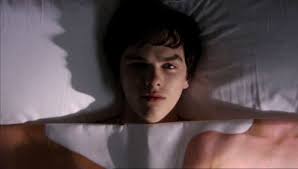

The first initial shot we see of Tony is a close up of his face, from this we can see the smug look of pleasure on his face as he has conveniently woken up before his alarm has gone off. The shot then pans out into a high angle shot where we see Tony lying in his bed under a duvet of a naked man and woman, funnily enough we see Tony in the middle of these two naked figures, this gives us the impression that maybe Tony is undecided of his sexuality being 'stuck in the middle' or maybe that he is bisexual being in the middle of the two genders.
The shot then jump cuts to Tony's alarm going off and him getting out of bed very swiftly. From this shot we can see Tony's room is very neat and tidy, his room is illuminated by the bright sunlight coming through the window, showing his room to be very clinical and bland, this could show a reflection of Tony's personality and proves my previous point of him not being a 'normal' teenager, as we would expect his room to be very messy and dark. We then see that he clearly has a daily routine when he gets up; turning off his alarm, stretching, working out, watching the woman across the street get dressed and then getting dressed himself. Filming all of this includes camera shots as mid shots of Tony's torso, long shot of Tony in the window and over the shoulder shot of the woman in the window across the street. We then move to a high angle shot of Effy walking down the street obviously looking worn out as she is scantily dressed from a night out. This is very ironic as we instantly see the massive contrast between the two siblings. On one hand we have Tony who isnt the 'typical' teenager: he is very organised, neat, well dressed and pedantic and on the other hand we have his younger sister Effy who is very much a stereotypical teenager: rebellious, sneeky and messy. The high angle shot of Effy shows her vunerabilty being the youger sibling and Tony looking down on her as the older, more responsible brother. Tony then pretends his CD player has broken, and distracts his dad whilst Effy sneaks in.
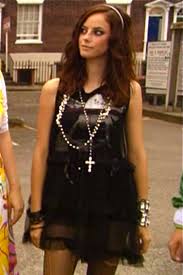 The sound used throughout the clip so far has been very varied. We move from the diegetic sounds of the church bells ringing and birds singing to the non-diegetic music which is pulsating and slow, building the scene up. We then return back to diegetic music as Tony puts his soundsystem on which is much more fast paced and louder and reflects the chaos he is about to cause by playing it and diegetic sound as his Dad comes in swearing and shouting at the high volume of the music. The dialogue between Tony and his Dad seems very well rehearsed like this isnt the first time Tony has woken his parents up to music blasting, we know this as his Dad says "every fucking morning" and the look on Tony's face shows he takes pleasure in winding up and annoying his Dad so easily.
We then move on to the next scene where Tony purposely locks himself inside the bathroom just to annoy his Dad, he then climbs out of the window, down the drainpipe and back into the house to take a seat in the kitchen. he does all of this whilst his Dad still thinks he is in the toilet, until his Dad comes downstairs and to his dismay sees Tony sat at the table eating his breakfast quite arrogantly and looking very smug at how easily he can annoy his Dad, we see Tony taking great pleasure in doing this which returns us back to the actions of a stereotypical teenager; going out of his way to annoy and wind up his parents. Tony is represented to have a very mistured and varied personality, some sides of him being very different to your average teenager and other sides being quite a normal annoying teenager. Tony however, over all doesnt seem to conform to the normal expectations of a teenager, whereas Effy does and having the contrast between the two siblings highlights the differences in how they act in everyday life, which isnt seem to be the norm for most teenagers in the UK.
Subscribe to:
Posts (Atom)