Showing posts with label Kickass. Show all posts

Friday, 7 December 2012

Marketing and Distribution Vs. Production Essay

“Successful media products depends as much upon marketing and distribution to a specific audience as they do upon good production processes.”  To what extent would you agree with this statement, within the media areas you have studied?

I do agree to an extent with the statement that within the media and film industry the distribution and marketing strategies heighten the economic success of the film as a whole. Marketing is one of the most important factors within the success of the film industry today because to make the revenue and box office placement desired, effective distribution is key.
Looking at the success economically with box office hit Prometheus, you can see instantly how marketing and distribution had a huge part to play. On the marketing side of things in Prometheus, prior to and after its release it was very heavily marketed mostly taken in the viral form. Examples of this are its interactive website (ProjectPrometheus.com), its collection of official pre-release viral clips (TED talk, David 8 and Quiet Eye, all featuring the leading characters in the film in non-fiction circumstances), teaser trailers, the Twitter trending hashtag #Areyouseeingthis and their 15m Twitter followers (which created a huge buzz on social networking sites during the anticipation before its release), TV Spots, Mark Kermode interview clips (BBC film critic talking about the release and reception of Prometheus) and the Alien films that Prometheus is thought to be linked with (helped to create a larger fan base for the film before it was released). All in all the mass of viral marketing created huge anticipation before the film’s release, people who had watched the Aliens films were raring to see the first viewing and it even attracted an audience of people who hadn’t seen any of the Alien films, all due to its heavy marketing that was almost infectious and impossible to escape whether you were a sci-fi fanatic or an all-round film watcher. The distribution within Prometheus was also something I thought was key to its success. Working with a distributor like 20th Century Fox through vertical integration (working on their own to distribute the film through a large network and audience base), a worldwide renowned distributor also part of the big six it was almost inevitably set up for success in the box office (approx. $400 million) and its anticipated DVD sales. Also with a budget of approximately $130 million its production process was hardly going to be bland. The production companies involved in the making of Prometheus were Scott Free Productions (Ridley Scott- Director and Producer’s own company), Brandywine Productions and 20th Century Fox all set up a huge synergy and helped to also create the success of the film. Having a well-known, respected and experienced Director and Producer such as Ridley Scott also helped to heighten the publicity and anticipation of the film through its marketing because an audience of avid Ridley Scott fans would be excited about a huge new release of his. Although the critical reception of the film wasn’t as great as originally thought due to its production, it had already received the box office success from its marketing and distribution triumph which conclusively lead to its profitable box office of over $400 million.
Secondly looking at the film Kickass which was also significantly marketed prior to its release and from its economical success you can see how important distribution and marketing really is was with this film in particular. Kickass was very heavily marketed before its release on 26th March 2010 because of its surrounding controversy in production (violence, drug use and explicit language involving a child) the distributors were worried it would not be received well and therefore released four TV Spots and four trailers (which some thought was a bit excessive and gave too much of the film away) but it still went on to make a box office of $96 million from its $28 million budget. The success of the film I think was due to its marketing and distribution not only did it have all the TV post and trailers but film magazines Empire and Total film covered the films journey from page t screen. Kickass was also pitched at San Diego Comic-Con, test screened in the UK (where it had mostly positive reviews and criticism from fans, journalists, distributors and film critics. The fan base Kickass had also created a huge marketing campaign virally and through word of mouth. Because some of the comics had already been released prior to its cinema release, fans had caught on with the storyline and fell in love religiously. They wrote reviews of the film and comic books and made their own posters, all in support of Kickass’ marketing. All of this conclusively lead to a heavy marketing campaign, a large fan base (before the film had even been released) and therefore a profitable film all in all. The distributors involved with Kickass also played a massive part in its economical success and appeal to a specific audience. Its UK distributor was Universal Pictures who are part of the big six distributing companies in the film industry and Lionsgate was the US distributor, although Lionsgate are not part of the big six, they are still a fairly successful and prestigious distribution company. This set Kickass up for success in the UK and the US, and it was shown worldwide on over 5000 cinema screens worldwide. The production side of Kickass was dealt with by Marv Films (Director & Producer Matthew Vaughn’s company, he funded $10m into the film out of his own money) and Plan B Entertainment (owned by Hollywood actor Brad Pitt). The production of the film Kickass was seen to be really successful as its DVD sales was significantly successful (unfortunately I couldn’t find an exact figure for this but plenty of articles stated that its figures were plentiful).
In conclusion, I feel even though during film making the production, actors and directing play a significantly big part in the success of the film it is still hugely reliant on the marketing and distribution factors. Because an audience can only really know about the production of the film itself once they have watched it and to want to spend their money and watch it they must persuaded through marketing and distribution campaigns/methods (the exception being if they are already avid fans of the actors or film topic in production) to do so. Also from studying Prometheus and Kickass you can see an international audience is vital to the film’s success when marketing and distributing and is a vital element to create a successful film both in profit and critically.

Thursday, 1 November 2012

How is media convergence important for audiences and institutions?

How is media convergence important for audiences and institutions?

Without media convergence I personally doubt the film industry would be where it’s at (success wise) today. The key areas of marketing, distributing and exhibiting a film all rely on media convergence to ensure the film is a hit with their target audience. It ensures a market for the film before it has even been released which is key to make sure it can succeed in the box office and make the revenue it deserves.
During the production of ‘Attack the Block’ the British film industry hardly recognised the importance of media convergence. It used a small segment of social networking (Twitter) to virally market the film with the occasional ‘teaser’ post to entice the audience in before the film’s release, however it wasn’t used enough to create a viral word of mouth necessary to help really market the film. However, Big Talk Productions, UK Film Council, StudioCanal and Film4 all worked together to produce, market, distribute and exhibit the film.  Seen as Attack the Block was a British film, with a fairly small budget, four smaller companies such as these working together is ideal to help the success of the film. This is because they all have experience in working with smaller films  (such as Shaun Of the Dead) and have previously achieved success in knowing the best ways to produce, market, distribute and exhibit films such as Attack the Block within their budget.  But, Attack The Block was still promoted in the usual ways of; TV adverts, cinema trailers, teaser trailers, UK & US official trailers, posters, magazine adverts, a soundtrack available for purchase on ITunes etc., interviews with TV programmes and journalists in the UK and US and exclusive interviews with the director Joe Cornish talking about the upcoming film with journalists in the UK and abroad. To add to all of this the film/media magazine Little White Lies dedicated a whole issue to Attack the Block. With all of this media used to help promote the film, Attack the Block was still only a small budget, British film and was therefore at a disadvantage when promoting and marketing the film before its release, especially outside the UK.
On the other hand we have the film Kickass. Still a British film, but working with a larger budget and larger production companies such as Universal Pictures, Lionsgate, Marv films and Plan B Entertainment (which is owned by Brad Pitt) is was already at an advantage compared to Kickass as these companies were on a much larger scale and were able to market and publicize the film more heavily. The good starting point with Kickass is that it was also written as a series of comic books alongside the film which helped to market the film through its media convergence and also helped to attract a more varied audience. Kickass also released five different trailers and four TV spots to help promote the film, despite its surrounding controversy. Kickass also took to film critics on forums, blogs and websites such as Rotten Tomatoes after it’s released which really helped its promotion through viral marketing and showed free distribution of its trailers and TV spots. Kickass was also very heavily advertised through its poster campaigns which were not only being distributed professionally by its advertisement campaign, but Kickass’ film ‘geek’ fans also produced their own versions of posters which concluded into a substantial amount and really helped to market the film through media convergence. Alongside all of this Empire and Total Film magazine covered the film and its journey from page to screen and film reviews were available on their websites too. The film was also pitched at San Diego Comic-con and the Empire magazine Movie-Con. All in all, this huge amount of marketing and promotion through media convergence was significantly important to its success in the Box Office and DVD/ Blu-Ray sales.
Media convergence is becoming more and more important, especially as technology is advancing; viral marketing is becoming more essential in the promotion and marketing of films. As stated before things like Social networking are becoming a huge part of the film industry, and mid-production marketing is happening more often thanks to this. The advance in technology is creating ways in which the audience can gain an interest in films throughout its production right the way through to its exhibition and sales. The music industry is more commonly working alongside films with soundtracks being released in accordance with films and helping to market them through different windows. In conclusion I would definitely argue the significant impact and importance of cross media convergence happening within films today is a positive and its ever growing methods of doing this are a real credit to the film industry and its importance for audiences and institutions.

Thursday, 4 October 2012

Kick-ass Filmmaking

kick-ass-2010-01


The idea:

The idea behind the film Kick-ass was taken from the comic book Kick-Ass which is a creator-owned comic book series written by Mark Millar. The film was produced by Matthew Vaughn and co-produced by Brad Pitt, Vaughn also directed Kick-ass. The comic book was orginally written by Mark Millar, but the film was co-wrote with Jane Goldman and Vaughn himself. At first Millar had the idea to bring comic book to the big screen and thats where he met jane Goldman who then introduced him to Matthew Vaughn (with whom she co-wrote the film Stardust with beforehand). Millar then pitched the idea to Vaughn who loved it and they plotted the whole film together in one afternoon.

Development Finance:

At first Kick-ass struggled to get a production company that would accept the script for what it was without any tweaks (such as decreasing levels in violence and swearing) in total seven production companys turned down the script before Vaughn released it through his own production company.  The big studios also doubted the success of the adaptation as a violent superhero, which forced the film to be independently financed by Vaughn however this gave him the freedom to make the film the way he imagined, without having to worry about any sensoring. However, Vaughn also had the help of Brad Pitt, which then meant because Pitt owns a film production company (Plan B Entertainment) that holds a release deal with Paramount Pictures, Warner Bros. and 20th Century Fox, Kick-ass now had a studio to film in.The film's budget was $30 million and its total income was approximately $96,188,903.

Script Development:

After meeting Vaughn, Millar then wrote a synopsis and then in parallel Millar wrote the comic and Vaughn wrote the script. This meant from the start Kick-ass was different from most other comic book movies, this was due to the fact the movie was in development at the same time as the comic book. Then, Vaughn wrote a first draft focusing on structure and story before Goldman added the dialogue and characterization, Goldman described her work with Vaughn as her job being the "construction work" and the "interior designing" while Vaughn acts as the "architect."

Packaging:

With the film deep in pre-production, Vaughn faced the scenario where he struggled to find an actor to fit the bill of 'Kickass' himself. In the struggle to find an actor to fit the character of Dave (Kickass) Vaughn almost had to pull the movie back six months, even though he had cast all the other roles. Then, Sarah Finn and Lucinda Syson (Vaughn's casting directors), encouraged him to take a look at a tape from a young actor called Aaron Johnson, which Vaughn had already previously turned down without viewing. Then after hearing Johnson read for the first time, Vaughn knew immediately Aaron would fit the role of Dave perfectly.

Production:

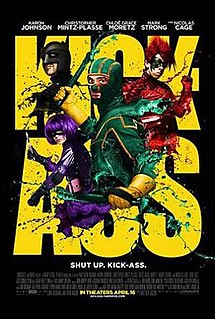
Kick Ass Movie PosterAs pointed out before Kickass was an independantly financed film due to the big studios doubt in the film's success. Christopher Mintz-Plasse, (Red Mist), said that the creators of the film were wondering whether a distributor would pick up the movie. On the set Vaughn jokingly referred to Kick-Ass as something that was going to be "the most expensive home movie I ever made."
The filming locations for Kickass include Hamilton, Ontario, Canada; Dip 'N' Sip Donuts on Kingston Road in Toronto, Sir Winston Churchill Secondary School, and "many Toronto landmarks that play cameos"; and various locations in the UK: Elstree Studios,
Whiteleys Shopping Centre in Bayswater London and Pinewood Studios, Iver Heath, Buckinghamshire. The opening sequence with Nicolas Cage was filmed in a sewage plant in East London.
On the other hand, the 2D/3D animated comic book sequence in the film took almost two years to finish. Romita created the pencils, Tom Palmer did the inks, and Dean White did the colours.
Kick-ass recieved a 15 rating from the BBFC and received an R rating by the MPAA (Motion Picture Association of America) for "strong brutal violence throughout, pervasive language, sexual content, nudity and drug use (some involving children). In an interview with Total Film, Aaron Johnson confirmed that the film stays true to the adult nature of the comic series by featuring a large amount of profanity and graphic violence.
The production companies involved in the making of Kickass were Marv Films and Plan B Entertainment (owned by Brad Pitt) and the  main distributors were Universal Pictures (UK) and Lionsgate Films (US) a full list of distributors and companies involved in the production of Kick-ass can be found on IMDb:
http://www.imdb.com/title/tt1250777/companycredits 


Sales:

Four different trailers altogether were released before Kick-ass premiered. They include the teaser trailer, the extended trailer and the international trailer. At first the teaser trailer caused some controversy due to the explicit language used by Chloe Moretz (Hit-Girl) but they still went on to released a red band trailer which displayed violence and use of the line "Okay you cunts, let's see what you can do now," delivered by ChloĆ« Grace Moretz, who was only eleven years old at the time of filming, this caused and upheaval by family advocacy groups for the use of violence and swearing. Along with this four TV spots were also released prior to the film being released,some fans said that too much footage was being seen too close to the release, however it still went on to be a huge hit in the box office and an even bigger hit in DVD and Blu-ray sales.

Teaser Trailer:


Extended Trailer:


International Trailer:


Red-Band Trailer:


Kick-Ass TV Spot - Story:


Kick-Ass TV Spot - Ordinary Heroes:


Kick-Ass TV Spot - Corridor:


Kick-Ass TV Spot: Big Four:


Marketing:

Kick-AssKick-ass was initially marketed through it original comic-books (published by Marvel Comics under the company's Icon imprint), which a few issues were already in shops to buy and read before the film was released. It also had the usual marketing techniques of posters on buses, in magazines on billboards etc, TV, cinema and DVD trailers. But Kickass was marketed really heavily in its poster and trailer campaigns because it was expected to be a huge success even though it was being surrounded by huge controversy in the early stages of production and development. Kick-ass released four trailers altogether and four TV spots, which some would say is too much coverage and gave too much of the film away. Nevertheless, it still went on to be a huge hit. Some of the main actors also did promotional tours which is where film actors, directors, and producers appear for television, radio, and print media interviews, sometimes showing a clip from the film or an outtake and talking about the film and their role in it. Empire and Total Film magazine covered the film and it's journey from page to screen and film reviews are available on their websites too.The film was also pitched at San Diego Comic-con and the Empire magazine Movie-Con. Kick-ass also took to viral marketing on fan's blogs and websites which showed free distribution of trailers and also gave reviews. Kick-ass also had a test screening in London at the BAFTA which was hosted by the UK distributor Universal, the people that attended this were Universal staff and other European distributors and then a smaller minority being the general public.


Exhibition:

A premier for Kick-ass was held in Leicester Square, London for the film, cast, directors, producers and screenwriters plus other special guests (including Brad Pitt). Kick-Ass made £3,881,704 (UK) on the opening weekend (4th April 2010)  and it was shown on 402 cinema screens across the country and on 5778 screens across the world on the opening weekend alone.
The film was released on DVD and Blu-ray on 3 August 2010 in North America, selling 1.4 million copies within its first week, one-third of these in Blu-ray format. Kick-Ass debuted at number one on the DVD sales chart and the discs were released in the United Kingdom on 6 September 2010.

Other Windows:

The foreground features the superhero Kick-Ass in his green and yellow costume. Against a black background the words KICK-ASS are written in yellow block capitals.A video game produced by WHA Entertainment and Frozen Codebase was released through the App Store on 15 April 2010, then another game was released on PlayStation Network on 29 April 2010. Kickass was nominated for twenty-five awards altogether, eventually going on to win seven of them. It won Best British Film at the Empire Awards and Best Comic-Book Adaptation and Best Blu-ray at the IGN Awards. Young actress Chloe Moretz scooped the other four awards for her perfomance: one as Best Newcomer at the Empire Awards, one at the IGN awards for Best Actress and two at the MTV Movie awards for Best Breakout Star and Biggest Badass Star.


Kick-ass has been reported by Universal (the distributors) for a sequeal Kickass 2
"The costumed high-school hero Kick-Ass joins with a group of normal citizens who have been inspired to fight crime in costume. Meanwhile, the Red Mist plots an act of revenge that will affect everyone Kick-Ass knows." -Synopsis. The same cast are due to return, plus a few new faces. Matthew Vaughn has chosen Jeff Wadlow, who also co-wrote the script along with Vaughn, to direct the sequel with filming planned to begin in September 2012.


Sources:

Wikipedia
IMDb